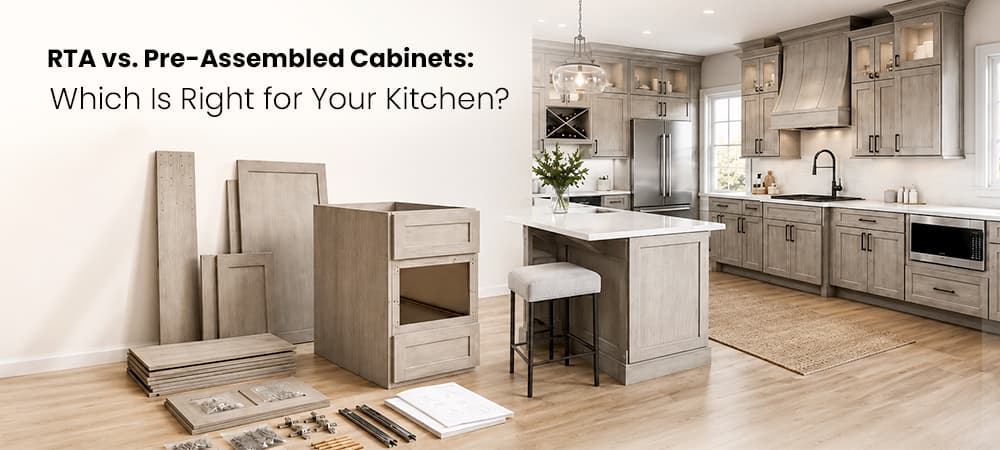
RTA vs. Pre-Assembled Cabinets: Which Is Right for Your Kitchen?
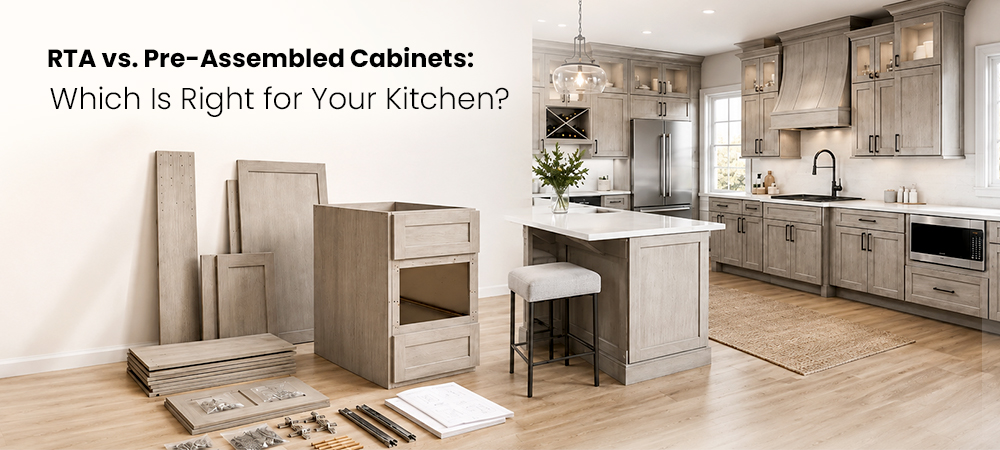
If you’ve started shopping for kitchen cabinets online, you’ve run into two options that look similar in photos but arrive at your door in very different ways: RTA (ready-to-assemble) cabinets and pre-assembled cabinets. Same door styles, same finishes, often the same manufacturer — so what are you actually choosing between?
The short answer: you’re choosing how much of the work happens in the factory versus in your kitchen, and how much you’ll pay for shipping and labor as a result. This guide breaks down the real differences so you can decide with confidence.
What Are RTA Cabinets?
RTA stands for ready to assemble. The cabinet arrives as a flat-packed box containing pre-cut, pre-drilled, pre-finished components — sides, back, bottom, face frame, doors, drawer boxes, and hardware. You (or your contractor) assemble each cabinet with a screwdriver or drill, typically in 15–30 minutes per box once you’ve done the first one.
Modern RTA is not the flimsy flat-pack furniture people remember from decades ago. Quality RTA lines use the same materials as assembled cabinetry: solid wood face frames and doors, plywood boxes, dovetailed drawer boxes, and soft-close hinges and slides. The construction method — cam locks, metal brackets, or wood dowels with glue — determines how solid the finished cabinet feels, so it’s worth asking how a specific line goes together before you buy.
What Are Pre-Assembled Cabinets?
Pre-assembled (sometimes called “fully assembled”) cabinets are the exact same cabinets, built in the factory or warehouse before shipping. They arrive as complete boxes, ready to be set in place and installed.
Nothing about the materials changes. What changes is the box on the truck: an assembled 36-inch wall cabinet takes up several times the shipping volume of its flat-packed twin, and it has finished faces that can be damaged in transit if it isn’t packed and handled carefully.
The Real Differences, Side by Side
| Factor | RTA | Pre-Assembled |
|---|---|---|
| Price | Lowest — you’re not paying for factory assembly labor | Typically 10–20% more per cabinet |
| Shipping cost | Lower — flat packs ship dense and stack efficiently | Higher — assembled boxes are mostly air |
| Freight damage risk | Lower — components are protected inside the box | Higher — corners and faces are exposed |
| Lead time | Often fastest; flat packs are easier to keep in stock | Sometimes adds assembly queue time |
| Labor at your end | Assembly required before install | None — set and install |
| Storage before install | Compact — a whole kitchen can wait in a garage bay | Bulky — assembled boxes eat a room |
| Quality ceiling | Same materials, same doors, same finishes | Same materials, same doors, same finishes |
Price: Where the Savings Actually Come From
Assembly labor is real money. When a warehouse team assembles your cabinets, that time is built into the price. When freight is calculated, an assembled kitchen can occupy two to three times the pallet space of the same kitchen flat-packed. On a 15-cabinet kitchen, those two factors together commonly swing the total by four figures.
That’s why RTA is the value play for budget-driven projects — and why contractors who buy cabinets regularly often default to RTA and assemble on site: they keep the savings.
Quality: The Myth That Won’t Die
“Are RTA cabinets lower quality?” is the most common question we hear, and the honest answer is: the letters R-T-A tell you nothing about quality. RTA and assembled versions of the same line use identical doors, identical plywood, identical hardware. Quality differences exist between brands and lines — box material (plywood vs. particleboard), drawer construction (dovetail vs. stapled), hinge and slide hardware — not between RTA and assembled versions of the same cabinet.
What assembly does affect is consistency. A factory-assembled cabinet was put together by someone who does it hundreds of times a week. A DIY-assembled cabinet is as square as the person who assembled it. If you follow the instructions, check for square with a tape measure corner-to-corner, and don’t overtighten cam locks, your result will be indistinguishable.
Time and Logistics
Think about your project timeline in three phases: ordering, receiving, and installing.
- Ordering: identical for both.
- Receiving: RTA wins on shipping speed and cost, and flat boxes are far easier to move into a house and stage in a garage. Pre-assembled cabinets arrive install-ready but need more space and more careful inspection for freight damage.
- Installing: pre-assembled wins — there is simply a missing step. Budget roughly 20–30 minutes of assembly per RTA cabinet; a typical kitchen of 12–18 cabinets is a comfortable weekend of assembly for one person, or a few hours for two.
Who Should Choose RTA?
RTA cabinets are the right call if any of these describe you:
- You’re budget-focused. The savings on cabinets plus freight is usually the single biggest line-item reduction available in a kitchen project without changing what the kitchen looks like.
- You’re reasonably handy. If you can assemble flat-pack furniture without drama, cabinet assembly is the same skill with better instructions and better hardware.
- Your contractor is installing. Most pros are happy to assemble RTA — many prefer it, because they can inspect every component before it goes on the wall.
- You’re phasing a project. Flat packs store compactly until each phase is ready.
- You’re shipping a long distance. Freight on assembled cabinets over long distances can get painful; flat packs keep it sane.
Who Should Choose Pre-Assembled?
Pre-assembled cabinets earn their premium when:
- Time is worth more than money on this project. If the install crew starts Monday and the drywall was finished Friday, arriving install-ready matters.
- Nobody in the chain wants to assemble. Some installers charge separately for assembly; compare that quote against the pre-assembled upcharge — sometimes factory assembly is genuinely cheaper than paying site labor to do it.
- The order is small. On a laundry room or a bathroom vanity run of three cabinets, the assembled upcharge is small in absolute dollars and the convenience is real.
- Local pickup is available. If you can pick up assembled cabinets locally instead of freighting them, the shipping-cost argument disappears. (This is exactly why we offer free local pickup at our Boynton Beach showroom — South Florida customers can get assembled cabinets without paying assembled freight.)
A Practical Hybrid: Mix Both
Nobody says the whole kitchen has to be one or the other. A pattern we see experienced buyers use: RTA for the bulk of the boxes, pre-assembled for the complicated pieces — tall pantry cabinets, corner units, or anything with internal rollouts where factory assembly removes the fiddliest work. You capture most of the savings and outsource the hardest 20% of the assembly.
Five Questions to Ask Before You Buy Either
- What is the box built from? Look for plywood construction — it holds fasteners and moisture better than particleboard, in RTA or assembled form alike.
- How do the drawers go together? Dovetailed solid-wood drawer boxes with undermount soft-close slides are the quality benchmark.
- How does the RTA version assemble? Cam-lock-plus-dowel and metal-bracket systems are both proven; ask to see an assembled sample in person if you can.
- What does freight actually cost for each version, delivered to my ZIP? Get the real number — this is where the comparison is usually decided.
- What’s the damage/replacement policy? Parts get damaged in shipping occasionally in both formats. A supplier who ships replacement components quickly matters more than a supplier who claims damage never happens.
Frequently Asked Questions
-
Are RTA cabinets hard to assemble?
Not for anyone comfortable with basic flat-pack furniture. Each cabinet arrives with pre-drilled holes and hardware sorted by step; the first box might take 45 minutes while you learn the system, and by the third you'll be down near 20. The only tools most lines require are a screwdriver or drill, a rubber mallet, and a clean flat surface to work on. Corner cabinets and tall pantries are the trickiest — save those for after you've warmed up on a few standard bases.
-
Do contractors charge extra to assemble RTA cabinets?
Some do, typically per cabinet. Ask for that number up front and compare it to the pre-assembled upcharge on your specific order — whichever is lower wins. Many installers fold light assembly into their install price because staging flat packs on site is genuinely easier than maneuvering assembled boxes through hallways.
-
Do RTA cabinets hold up as long as pre-assembled?
Assembled correctly — glue where specified, cam locks snug, box checked for square — an RTA cabinet is structurally the same cabinet and lasts just as long. Longevity comes from the materials (plywood box, quality slides and hinges), which are identical either way.
-
Can I return RTA cabinets after assembly?
Generally no — assembly counts as acceptance at most retailers. That's another reason to inspect every component against the packing list before you build, and to order a sample cabinet first if you're unsure about a line.
-
Which option ships faster?
Usually RTA. Flat-packed cabinets are what distributors keep deepest in stock, and they move through freight networks with less damage-related delay. If your timeline is tight, ask for current lead times on both formats for the specific line you want — the answer varies by manufacturer and by month.
The Bottom Line
RTA and pre-assembled cabinets are the same product at two points on a convenience curve. Pay more, do less; pay less, do a weekend of light assembly. Quality lives in the brand and construction specs — not in whether the cabinet arrived flat.
If you’re within driving distance of South Florida, the easiest way to decide is to stand in front of both: visit our Boynton Beach showroom, open the drawers, feel the difference between door styles, and see an RTA cabinet assembled next to a factory-assembled one. Shopping from elsewhere in the country? Every line we carry ships nationwide — order door samples, compare specs, and call us at 954-667-2148 with your layout and we’ll help you price the same kitchen both ways.
RTA Cabinets Fast sells ready-to-assemble and pre-assembled cabinets online and from our Boynton Beach, FL showroom, with nationwide shipping and free local pickup.