Kitchen Cabinet Door Styles Explained: How to Choose the Right Look
Here’s a secret of kitchen design: the door does almost all the work. Cabinet boxes are boxes — what your eye reads as “modern,” “farmhouse,” or “traditional” is 90% the door style and finish. Which means the single highest-leverage decision in your cabinet order isn’t the brand or even the color. It’s the door.
This guide walks through the major door styles, what each one says visually, and the practical stuff nobody mentions in the showroom — like which profiles collect dust and which hide fingerprints.
First, Two Terms Worth Knowing
Framed vs. frameless construction. American-style framed cabinets have a face frame around the box opening; the door sits on or inside that frame. European-style frameless (“full access”) cabinets skip the frame — the door covers nearly the whole box. Frameless reads sleeker and gains a bit of interior space; framed is the traditional look and slightly more forgiving to install.
Overlay. How much of the frame the door covers: partial overlay (frame visible around every door — traditional, budget-friendly), full overlay (doors nearly touch — the current mainstream standard), and inset (door sits flush inside the frame — the premium furniture look, at a premium price).
Now, the doors themselves.
Shaker: The Style That Won
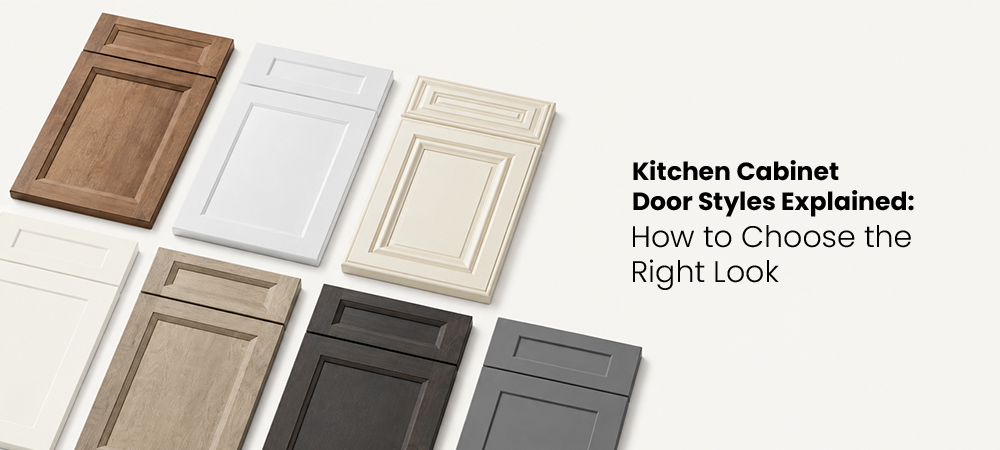
If you’ve looked at a kitchen photo in the last decade, you’ve seen Shaker: a flat center panel framed by a simple square-edged rail-and-stile border. Born from Shaker furniture-making principles — no ornament, honest proportions — it has become the default door of American kitchens for a reason: it’s the chameleon.
- Reads as: transitional — equally at home in modern farmhouse, classic, and contemporary kitchens
- Pairs with: literally everything; hardware choice steers the style (cup pulls → farmhouse, slim bar pulls → modern)
- Cleaning: the inside edge of the frame catches some dust and grease; a quarterly wipe handles it
- Resale: the safest choice on this list — Shaker white and Shaker gray remain the best-selling kitchen combinations in the country
- Budget note: because every manufacturer makes one, Shaker offers the widest price range and the easiest apples-to-apples comparison shopping
Variants worth knowing: skinny Shaker (narrower rails, more modern) and beaded Shaker (a fine inner bead, more traditional).
Slab: Minimalism, Literally
A slab door is a single flat panel — no frame, no profile, nothing. It’s the door of European modern design, and it’s having a sustained moment in high-gloss finishes, matte lacquers, and wood grains laid horizontally.
- Reads as: modern, urban, architectural
- Pairs with: frameless boxes, handleless or edge-pull hardware, waterfall countertops
- Cleaning: the easiest door on this list — one flat surface, zero crevices. But glossy slabs show fingerprints enthusiastically; matte finishes and textured wood grains hide them
- Resale: strong in condo and contemporary markets; can feel stark in traditional neighborhoods
- Budget note: entry-level slab is the most affordable door made, while premium high-gloss European slab is among the priciest — the label “slab” tells you shape, not price
Raised Panel: The Classic
The raised panel door — a center panel with a profiled, raised contour inside a decorative frame — was the American kitchen door for decades. It reads formal, substantial, and traditional.
- Reads as: traditional, stately; cathedral-arch versions read distinctly classic
- Pairs with: crown molding, glazed finishes, antique brass or oil-rubbed bronze hardware
- Cleaning: the most profile to dust of any door here; grease settles into the panel contours near the range, so plan on more frequent wipe-downs in cooking zones
- Resale: beloved in traditional markets, dated in modern ones — know your neighborhood
- Budget note: more machining means raised panel typically costs more than Shaker in the same line
Flat Panel / Recessed Panel Beyond Shaker
Shaker is technically a recessed flat-panel door, but the family is bigger: doors with wider rails, stepped or applied moldings, or mullion detailing sit between Shaker’s simplicity and raised panel’s formality. If Shaker feels too plain and raised panel too ornate, this middle territory — sometimes labeled “transitional” doors — is where to look.
Glass-Front, Mullion & Open Styles
Glass-front doors (clear, seeded, or frosted glass in a frame, sometimes divided by mullions) aren’t a whole-kitchen choice — they’re an accent. One or two glass uppers flanking a range hood or over a coffee station breaks up a wall of doors and displays the good dishes. Practical notes: interiors of glass cabinets need to stay tidy, and glass adds cost per door — use them where they earn it.
Specialty Profiles: Beadboard, Louvered, Arched
- Beadboard panels (vertical grooves) bring cottage and coastal charm — and the honest warning that those grooves are the dustiest surface in cabinetry.
- Louvered doors suit ventilated spots (laundry, pantry) and tropical looks.
- Arched top rails (cathedral) are a traditional signature that instantly dates a kitchen to buyers who don’t share the taste — a strong choice, in both directions.
How to Actually Decide: Four Filters
- Start with the kitchen you can’t change. Your home’s architecture votes first. A 1920s bungalow fights a glossy slab; a glass condo tower fights cathedral raised panel. The door doesn’t have to match the house’s era, but it shouldn’t argue with it.
- Apply the 10-year test. Cabinets outlast trends. If you loved a style before it trended (or independent of the trend), that’s a keeper signal. If you first saw it this year on social media, let a sample door sit in your kitchen for two weeks before committing.
- Be honest about cleaning. Rank the doors you’re considering by crevice count, then rank your tolerance for dusting. Slab < Shaker < transitional < raised panel < beadboard. There is no wrong answer, only mismatched expectations.
- Let resale break ties — not make decisions. If you’ll sell within five years, Shaker in a light neutral is the statistical safe play. If this is your fifteen-year kitchen, buy the door you love and let the next owner worry about themselves.
A Quick Word on Materials and Finishes
Door style and door material are separate decisions, and the same profile behaves differently in each material:
- Solid wood / wood veneer: the classic for painted and stained doors alike. Real wood moves with humidity — hairline joint lines on painted five-piece doors (like Shaker) are normal seasonal behavior, not defects. Stained wood hides wear best because color goes through the surface.
- MDF: dimensionally stable and smooth, which is why many premium painted doors use MDF center panels or full MDF construction — no seasonal joint lines, flawless paint surface. It’s a quality choice for paint, not a shortcut.
- Thermofoil / laminate / acrylic: vinyl or laminate skins over an engineered core, common in slab doors. Extremely easy to clean and consistent in color; keep them away from sustained high heat (use heat shields beside ranges where the manufacturer specifies).
On sheen: matte and satin finishes hide fingerprints, dust, and small scratches far better than gloss. High-gloss looks spectacular in photos and showrooms — budget real cleaning commitment for it in a busy household, especially in dark colors.
Frequently Asked Questions
-
What’s the most popular cabinet door style right now?
Shaker, by a wide margin — most commonly in white, followed by grays, deep blues, and greens. Skinny-Shaker and slab are the fastest-rising alternatives as kitchens trend more contemporary.
-
Which door style is cheapest?
Within any single manufacturer’s line, simpler machining costs less: slab and basic Shaker typically sit at the bottom of the price ladder, raised panel and specialty profiles at the top. Across brands, though, line quality moves price more than profile does — a premium Shaker easily costs more than a budget raised panel.
-
Can I mix door styles in one kitchen?
Yes, within reason. The proven combinations keep one style per zone: glass-front or open uppers as accents, a contrasting island in the same profile but different color, or slab drawer fronts under Shaker doors for a subtle modern touch. Mixing more than two profiles usually reads as accidental.
-
Do door styles affect cabinet lead time?
Sometimes. Core styles in stock finishes ship fastest; specialty profiles, glazes, and custom colors can add weeks. If your timeline is fixed, ask about lead time per style before you commit your heart.
See Doors in Person Before You Order
Door style photos lie a little — profile depth, finish sheen, and color all shift under real light. Before ordering a kitchen’s worth of any door: get physical samples. Set them against your flooring and wall color, look at them in morning and evening light, and run a greasy thumb across the finish to see what daily life will look like.
We stock door samples across every line we carry — Shaker to slab to raised panel — and new door styles are added as manufacturers release them. South Florida shoppers can compare dozens of styles side by side at our Boynton Beach showroom; everyone else can order samples to their door, and our team at 954-667-2148 will talk through how each style prices out across manufacturers for your specific layout.
The box holds your dishes. The door makes your kitchen. Choose the door first.
RTA Cabinets Fast sells ready-to-assemble and pre-assembled cabinets online and from our Boynton Beach, FL showroom, with nationwide shipping and free local pickup.